As we get closer to the end of June, most lawyers, at least in Arizona, start checking how many Continuing Legal Education (CLE) hours they have left to complete. By June 30, every lawyer in Arizona must report 15 CLE hours, including 3 hours of ethics. Unless you are a certified specialist, 12 of those hours can be in almost any area of legal education. For certified specialists, there are additional requirements for advanced education within your specialty. As the deadline approaches, it is tempting to ask the question: What is the fastest way to get my hours done?
We are all busy. Cases are demanding. Clients need attention. Family obligations do not stop because the CLE reporting deadline is approaching. But if that is the only question we ask, I think we miss a tremendous opportunity.
CLE requirements exist because the law is constantly changing and because there is always more to learn. Having to take 15 hours of classes each year gives us the opportunity to expand our knowledge and hone our skills. Yes, it is a mandatory opportunity, but it is an opportunity nonetheless.
When I was a younger lawyer, I used to worry about getting all of my CLE hours completed before the deadline. Suddenly it would be June, and I would be scrambling to find enough hours to satisfy the requirement. Like many lawyers, I viewed CLE as another item on a very long to-do list.
Over time, I changed my approach. I started paying attention to the lunch-hour CLE emails that arrived in my inbox. I made a point of attending one every month or so. Then I took it a step further and started reading the descriptions of upcoming programs. Instead of looking at CLEs as an obligation, I began viewing them as an opportunity to learn something new, revisit an area of law I had not thought about recently, or deepen my understanding of a topic that interested me.
The result was predictable. By the time June arrived, I usually had more than enough hours and often had carryover credits for the following year. More importantly, I was actually learning.
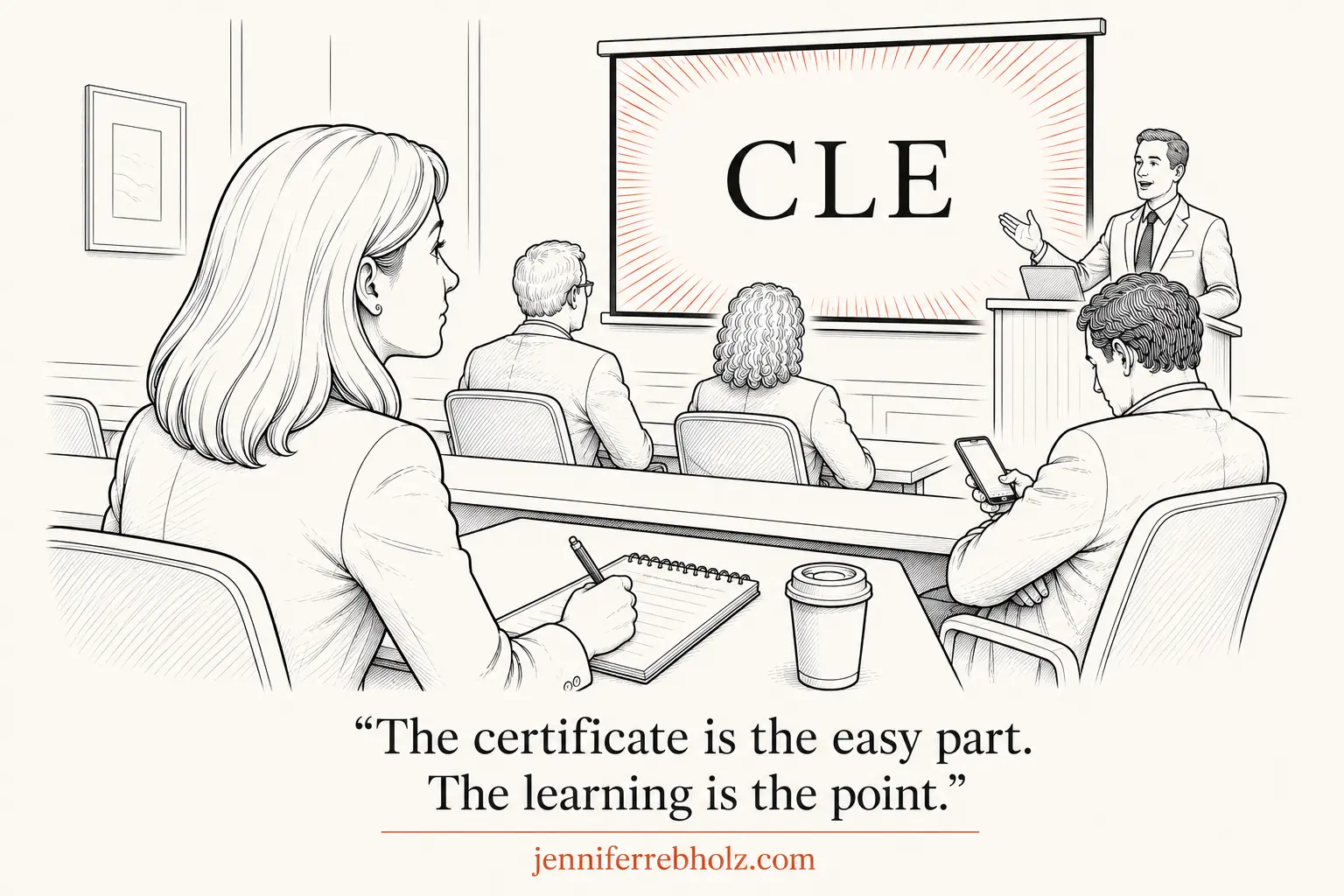
That part requires some effort. It is difficult to absorb much from a CLE that is playing on one screen while you answer emails, draft motions, or prepare for a deposition on another. Real learning requires paying attention. It requires finding a topic that interests you and giving it your focus. The good news is that there are more opportunities than ever to do that. The State Bar, local bar associations, affinity bars, specialty organizations, and private providers offer programs throughout the year.
Many are available on demand now, which is convenient, but I still prefer attending live whenever possible. Whether in person or by Zoom, live programs tend to be more engaging. You can ask questions, hear different perspectives, and participate in the discussion. I also find that when I commit to attending a live program, I am more intentional about what I choose. I look for subjects I genuinely want to learn about or speakers whose presentations I know I will enjoy. As a result, I walk away with something more valuable than a CLE certificate.
As you get ready to report your hours this year, consider making a plan for next year. Think about the areas of law you want to understand better. What issues keep coming up in your cases? What skills would make you a better advocate? What topics simply interest you?
The lawyers who continue to grow are usually the ones who stay curious.
One of the best parts of practicing law is that there is always something new to learn. The lawyers who continue to grow are usually the ones who stay curious. So the next time a difficult issue lands on your desk, you may find that a CLE you attended six months ago gave you exactly the idea, argument, or perspective you needed. That is a much better return on your time than simply checking a box before June 30.